
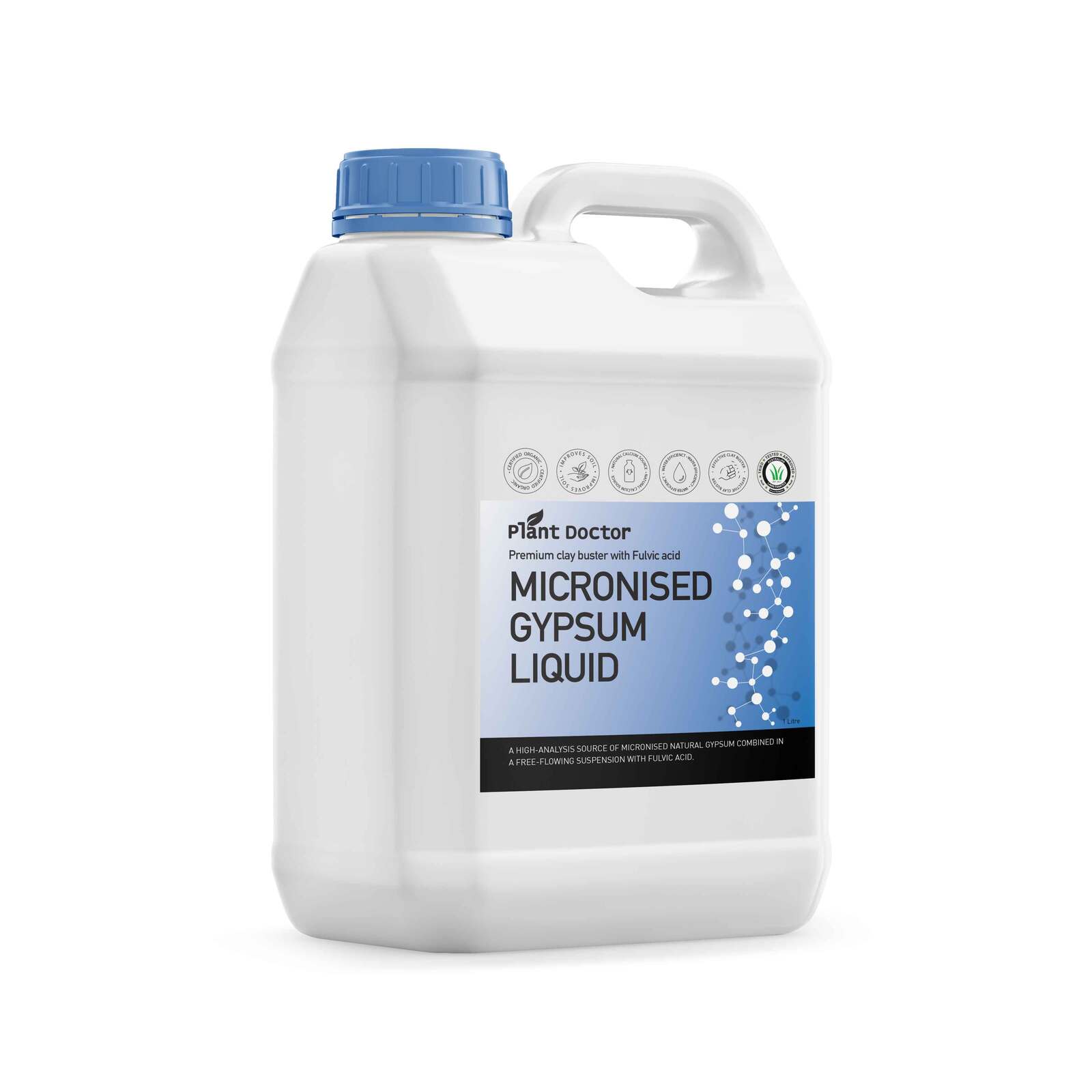
Micronised Gypsum – The Premium Liquid Clay Buster
Healthy soil provides the foundation for healthy plants. But when soil becomes compacted, poorly structured or affected by excess sodium, water movement and root development can suffer.
Micronised gypsum is a convenient way to supply calcium and sulphur while supporting better soil structure. Unlike conventional powdered or granular gypsum, micronised gypsum is processed into extremely fine particles and suspended in a liquid formulation, making it easy to measure, mix and apply.
But is gypsum suitable for every soil? How does it actually work? And is liquid gypsum really better than traditional gypsum?
In this guide, we'll explain what micronised gypsum is, how it works in soil, where it can be useful, and how to get the most from it in gardens, lawns, turf and agricultural systems.
What Is Micronised Gypsum?
Gypsum is a naturally occurring mineral known chemically as calcium sulphate dihydrate. It provides two important plant nutrients:
- Calcium (Ca) – important for cell wall development, root growth and overall plant structure.
- Sulphur (S) – essential for protein synthesis, enzyme activity and chlorophyll formation.
Micronised gypsum has been processed into very fine particles. The smaller particle size provides greater surface area, allowing the material to dissolve and release calcium and sulphur more readily. Because it is supplied as a liquid suspension, micronised gypsum can also be easier to apply accurately than large quantities of traditional powdered gypsum. It can be incorporated into soil management programs across gardens, turf, horticulture, agriculture and other growing systems where calcium and sulphur are required or where soil structure needs attention.
How Does Gypsum Work in Soil?
One of the best-known uses of gypsum is improving the structure of certain clay and sodic soils. The key here is calcium. Clay particles can become dispersed when there is an imbalance of exchangeable cations, particularly when sodium levels are high. Dispersed clay can block soil pores, reducing water infiltration and making the soil difficult to work. Calcium supplied by gypsum can help displace sodium from the soil exchange complex. This encourages clay particles to come together, or flocculate, helping form more stable soil aggregates. Better aggregation can improve:
- Water infiltration
- Drainage
- Air movement through the soil
- Root penetration
- Soil workability
- The movement of water through the root zone
However, gypsum isn't a universal solution for every clay soil. A soil may be hard or compacted because of traffic, poor organic matter levels, excessive cultivation, poor drainage or physical compaction rather than sodicity. In these situations, gypsum may not be the answer.
Soil testing is the best way to determine whether gypsum is appropriate for your soil.
Key Benefits of Micronised Gypsum
Here’s why this product has gained popularity among a wide range of users – from commercial growers to backyard gardeners:
| Improves Soil Structure: | Gypsum is traditionally used to break up heavy clay soils, improving drainage and aeration. It does this by replacing sodium with calcium on soil particles, encouraging better aggregation and crumb structure. The micronised version does this much faster and more effectively thanks to the tiny particle size. |
| Delivers Essential Nutrients: |
Micronised gypsum contains Calcim and Sulfur which are delivered in a highly available form, making it ideal for fast uptake:
|
| Convenience & Precision: | Applying powdered gypsum can be messy and labour-intensive. Liquid micronised gypsum is easier to apply, whether through fertigation systems, watering cans, boom sprayers, or foliar applications. You also get more precise control over dosage and placement. |
| Clay-Busting Capacity: | A single 25L drum of micronised gypsum offers the soil-conditioning power equivalent to 1 tonne of conventional gypsum in terms of immediately available calcium, offering incredible efficiency. |
| Ideal for Diverse Soils: | Works as a clay buster in heavy, compacted soils. Acts as a “spoon-feeding” supplement for sandy soils where nutrients easily leach away. Helps balance sodium and magnesium levels in problematic soils. |
| Improves Plant Growth & Yield: | By improving soil structure and nutrient uptake, plants can grow stronger roots, access water more effectively, and produce better yields – especially sulfur-hungry crops like canola and root vegetables. |
Micronised Gypsum for Clay and Sodic Soils
Gypsum is particularly associated with the management of sodic soils. Sodic soils contain elevated levels of exchangeable sodium, which can cause clay particles to disperse. When this happens, soil pores can become blocked, reducing infiltration and creating poor drainage and difficult growing conditions. Adding a source of calcium such as gypsum can help improve the balance between calcium and sodium on the soil exchange complex. Over time, improved aggregation can support better movement of water and air through the soil. If you suspect you have a sodic soil, soil testing can provide valuable information about exchangeable sodium, calcium, magnesium and other soil properties.
What About Sandy Soils?
Sandy soils present a different challenge. Unlike heavy clay, sandy soil generally has larger particles and drains quickly. It can also have a lower capacity to hold nutrients and water. Micronised gypsum can still be useful as a source of calcium and sulphur where those nutrients are required, but gypsum shouldn't be viewed as a universal solution for improving sandy soil. For sandy soils, building organic matter, improving water management and using appropriate fertilisers and soil conditioners may be equally or more important. A balanced soil improvement program should address the specific limitations of the soil rather than relying on a single amendment.
Product Analysis
Plant Doctor Micronised Gypsum contains:
| Component | Value |
|---|---|
| Calcium (Ca) | 16.5% |
| Sulphur (S) | 13.0% |
| Specific Gravity | 1.42 |
| pH | 6.9 |
| Appearance | Thick off-white/cream liquid |
The combination of calcium and sulphur makes micronised gypsum a useful amendment where both nutrients are required, while its fine particle size and liquid formulation make application convenient.
How to Apply Micronised Gypsum
Application rates will depend on the crop, soil conditions and application method. Always follow the current product label and technical recommendations for your particular use.
| Home Gardens |
For home gardens, micronised gypsum can be diluted in water and applied directly to the soil around plants. For the Plant Doctor product, the recommended home garden application is: 45 mL per 9 L watering can, applied at 1 L of diluted solution per square metre. Apply according to soil and crop requirements rather than automatically treating on a fixed schedule. |
| Turf and Lawns |
Micronised gypsum can be incorporated into a turf management program where soil testing or growing conditions indicate that gypsum is appropriate. It may be particularly useful where soil structure or calcium availability is a concern. For best results, consider gypsum alongside other important aspects of lawn management, including aeration, irrigation, fertilisation and organic matter management. |
| Vegetables and Horticultural Crops |
Micronised gypsum can be used in vegetable and horticultural production as a source of calcium and sulphur and, where appropriate, as part of a soil amelioration program. Application rates should be selected according to crop requirements, soil conditions and the recommended product directions. |
| Agriculture, Pastures and Broadacre Crops |
For broadacre crops and pasture, application should be based on soil and crop requirements. Gypsum can be particularly relevant where soil testing identifies sodicity or a requirement for additional calcium and sulphur. For large-scale applications, calibrated equipment and appropriate agitation are important to ensure an even application. |
| Application Tips |
Micronised gypsum is a suspension, so some settling can occur during storage. For consistent application:
Because micronised gypsum is a mineral suspension, visible residue may occur on surfaces following some spray applications. |
Should You Use Gypsum on Your Soil?
The answer depends on what is happening in your soil. Gypsum can be a valuable soil amendment, but applying it simply because you have "bad clay" isn't always the best approach. Before applying gypsum, consider:
Is the soil sodic?
High sodium levels and clay dispersion are strong indicators that gypsum may be useful.
Does the soil need calcium or sulphur?
Soil testing can help identify nutrient requirements.
Is the problem actually compaction?
If physical compaction is the main issue, aeration and reducing traffic may be more appropriate.
Does the soil have enough organic matter?
Organic matter plays an important role in soil structure, water retention and biological activity.
How is the soil draining?
Poor drainage can have many causes, so it's important to identify the underlying problem before choosing an amendment.
Who Can Use Micronised Gypsum?
Micronised gypsum can be useful across a range of growing environments.
- Home Gardeners: For gardeners looking to improve soil conditions while supplying calcium and sulphur to vegetables, flowers and other plants.
- Lawn and Turf Managers: For maintaining turf where soil structure, calcium availability or sodicity is identified as a concern.
- Farmers and Growers: For agricultural systems where soil testing indicates a requirement for calcium or sulphur or where sodic soil conditions need to be addressed.
- Horticultural Growers: For orchards, vineyards and intensive horticultural production where precise nutrient and soil management is important.
Best Practices for Better Soil Health
Gypsum works best when it is part of a broader soil management strategy. For healthier soil, consider combining appropriate soil amendments with:
- Regular soil testing
- Good organic matter management
- Appropriate fertilisation
- Effective irrigation
- Aeration where necessary
- Minimising unnecessary soil compaction
- Maintaining healthy root systems
- Managing drainage and water movement
Remember, there is no one-size-fits-all solution for soil health. The best amendment is the one that addresses the actual limitation in your soil.
| Frequently Asked Questions | |
|---|---|
| Can I use micronised gypsum on lawns? | Yes. Micronised gypsum can be used in turf and lawn management where soil conditions indicate that gypsum is appropriate. It can supply calcium and sulphur and may support improved soil structure in suitable soils. |
| Is micronised gypsum suitable for clay soil? | It can be, particularly where clay dispersion or sodicity is contributing to poor soil structure. However, not every clay soil requires gypsum. Soil testing can help determine whether it is appropriate. |
| What is the difference between gypsum and micronised gypsum? | Both products are forms of gypsum, or calcium sulphate dihydrate. Micronised gypsum has been processed into much finer particles, increasing its surface area and allowing it to dissolve more readily. Its liquid formulation also makes it convenient to measure and apply. |
| Does gypsum change soil pH? | Gypsum is generally considered a neutral soil amendment and does not have the same liming effect as products such as agricultural lime. Its primary roles are supplying calcium and sulphur and helping address certain soil structure problems. |
| How long does gypsum take to work? | The timeframe depends on the soil, the underlying problem, moisture conditions and application method. While micronised gypsum can dissolve readily because of its fine particle size, improvements in soil structure are a process rather than an instant change. |
| Is micronised gypsum organic? | Gypsum is a naturally occurring mineral. Whether a particular gypsum product is permitted under an organic certification program depends on the product and the requirements of the relevant certification body. Always check the certification requirements that apply to your operation. |
| Can gypsum fix compacted soil? | Not necessarily. Gypsum is most useful where soil structure problems are related to sodicity or clay dispersion. Physical compaction caused by traffic, machinery or other factors may require aeration or changes to soil management practices instead. |
Final Thoughts
Micronised gypsum is more than simply a source of calcium and sulphur. In the right soil, it can play an important role in improving soil structure and supporting better water movement through the root zone. Its fine particle size and convenient liquid formulation also make it easy to incorporate into a wide range of soil and crop management programs. However, the key to using gypsum successfully is understanding why your soil needs it. Heavy clay doesn't automatically mean gypsum is required, and compacted soil doesn't always have a gypsum problem. Start with your soil. Where testing indicates sodicity, calcium requirements or other conditions that make gypsum appropriate, micronised gypsum can be a valuable addition to a broader soil health program.
Looking for a convenient way to apply calcium and sulphur while supporting better soil management? Explore Plant Doctor Micronised Gypsum – our Premium Liquid Clay Buster.
Products in this article
Micronised Gypsum Liquid Premium Clay Buster

Leave a comment